

MALARIA: Policy implementation gaps weaken Tanzania’s fight against insecticide-resistant mosquitoes
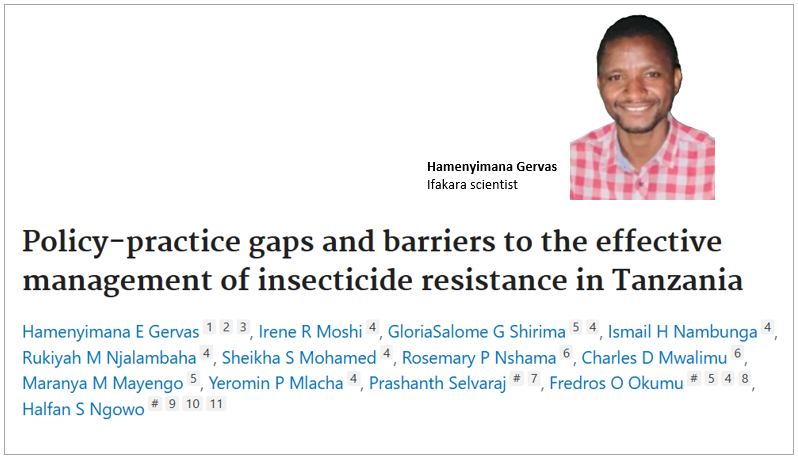
A new study led by scientists at the Ifakara Health Institute and partners has found that although Tanzania has developed strong national policies to tackle insecticide resistance in malaria mosquitoes, major gaps in implementation are limiting their effectiveness.
Published in the Malaria Journal recently, the study found that Tanzania's malaria vector control strategies are closely aligned with recommendations from the World Health Organization (WHO). However, many of the measures needed to detect, monitor, and respond to insecticide resistance are not being implemented consistently across the country.
The study was led by scientists at the Ifakara Health Institute, Tanzania’s National Malaria Control Programme (NMCP) and the Gates Foundation. Ifakara scientist Hamenyimana Gervas served as lead author alongside Dr. Halfan Ngowo, Dr. Fredros Okumu (from Ifakara) and Prashanth Selvaraj (from Gates Foundation), who served as co-last authors.
Why these findings matter
The findings come at a critical time, as increasing resistance threatens the effectiveness of insecticide-treated bed nets and indoor residual spraying—two of the world's most important malaria prevention tools.
The tools remain the backbone of malaria control, but their effectiveness depends on timely detection of insecticide resistance. Without consistent surveillance and implementation of resistance management strategies, there is a risk that malaria programmes may continue relying on interventions that are becoming less effective, potentially slowing progress in reducing malaria transmission and disease.
Policies are strong, but practice lags behind
Researchers reviewed Tanzania's National Malaria Control Programme (NMCP) policies, strategic plans, and technical reports published between 2014 and 2024 alongside WHO guidelines and reports on insecticide resistance monitoring and management. They also conducted in-depth interviews with 24 stakeholders, including policymakers, scientists, funding partners, technical experts, and malaria control implementers at regional and district levels.
The review found that Tanzania has established comprehensive strategies for monitoring and managing insecticide resistance. Yet implementation remains limited.
According to the study, routine insecticide resistance surveillance is conducted in only 22 of Tanzania's 184 district councils, leaving most districts without the data needed to determine where resistance is emerging or whether existing mosquito control interventions remain effective.
What are the barriers to implementation?
Stakeholders identified several factors preventing national strategies from being fully translated into action.
The most commonly cited challenges were inadequate funding, heavy dependence on donor support, shortages of trained personnel, weak coordination among institutions, and limited dissemination of technical guidance to district-level implementers.
Researchers also found that community engagement remains limited, with local communities and district authorities playing only a minimal role in insecticide resistance monitoring and management despite being central to malaria control efforts.
Closing the gap between policy and practice
The researchers conclude that bridging the gap between policy and practice will be crucial to sustaining recent gains in malaria control and keeping Tanzania on track to eliminate malaria by 2030.
They add that addressing policy-practice gaps will be essential to protecting the effectiveness of current malaria control tools. "Addressing these persistent challenges will be essential for more effective malaria vector control and will require sustained financing, stronger coordination, improved vector monitoring, and greater community and intersectoral engagement."
Read the publication, here.
We're a Registered Charity Organization in Tanzania
Ifakara Health Institute (IHI) is officially recognized as a charitable organization under the Income Tax Act. Certification issued on 20 March 2025 and valid until 31 December 2030.
Ifakara Health Institute (IHI) is officially recognized as a charitable organization under the Income Tax Act. Certification issued on 20 March 2025 and valid until 31 December 2030.