
PUBLIC KNOWLEDGE: Bagamoyo general population strongly supports clinical trials despite knowing little about them
The general population in Tanzania's Bagamoyo District is largely willing to participate in medical research despite having low knowledge about how clinical trials work, according to a new study led by scientists from Ifakara Health Institute and partners.
Published in the International Journal of Environmental Research and Public Health, the study surveyed nearly 400 adults between February and May 2024. It found that while awareness and understanding of clinical trials were generally low, attitudes towards participation were largely positive.
Researchers say the findings present both an opportunity and a challenge for public health research. Communities appear willing to contribute to medical advances, but need better information to make informed decisions.
Why clinical trials matter
Clinical trials are essential for testing the safety and effectiveness of new medicines, vaccines and other health interventions. They help researchers determine whether treatments are safe and effective before they can be introduced for wider use.
As countries continue to address both long-standing and emerging health challenges, public participation in clinical research remains critical to advancing healthcare and improving patient outcomes.
Limited understanding but positive perception
The study found that most participants had limited knowledge of clinical trials, with many scoring below 60% on measures assessing their knowledge of clinical trials. Knowledge gaps were more common among men, older adults and unemployed individuals.
Despite this, attitudes toward participation were largely positive with many respondents, particularly women, expressing a willingness to participate in clinical trials.
Building informed participation
The findings come as clinical research continues to play an important role in addressing health challenges across Africa.
While willingness to participate is encouraging, researchers emphasize that informed participation is essential for ethical and effective research.
“People’s willingness to participate is encouraging,” the researchers noted. “However, these findings underscore the importance of tailored health education interventions, particularly for older adults and the unemployed, who may face barriers to understanding or accessing trial opportunities.”
Closing the knowledge gap
The study calls for targeted community education to improve understanding, particularly among older adults and unemployed groups.
It also recommends stronger outreach and awareness programmes to support informed engagement without undermining existing trust in research.
Study led by young Ifakara researcher
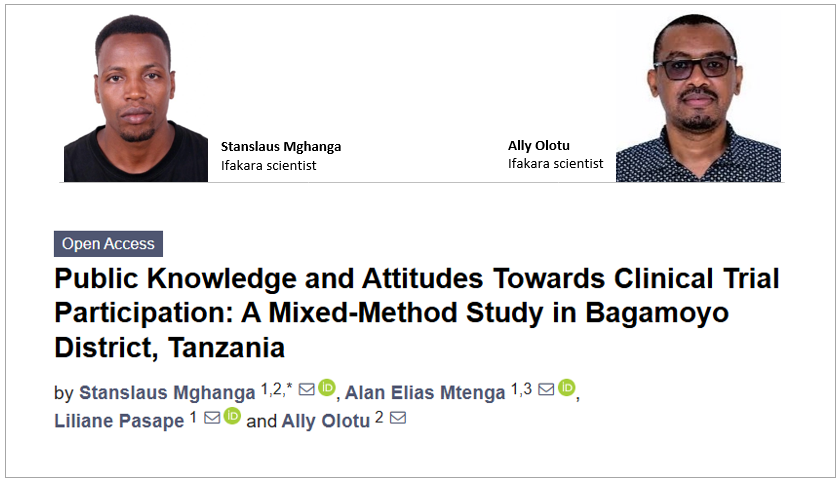
The study was led by Stanslaus Mghanga as part of his master's research under the supervision of Dr. Ally Olotu, a senior scientist at Ifakara Health Institute.
The research team also included collaborators from The Nelson Mandela African Institution of Science and Technology (NM-AIST) and the Kilimanjaro Clinical Research Institute (KCRI).
Read the publication here.