

CITIZEN SCIENCE: Building trust through dialogue on gene drive research
A new study has documented a three-year dialogue between scientists and Indigenous Peoples and local communities, demonstrating how emerging technologies can be discussed in ways that place trust, relationships and mutual understanding at the centre of the conversation.
The study explores how scientists and Indigenous Peoples and local communities worked together to create a culturally grounded space to discuss gene drive technology—an emerging genetic tool designed to spread specific traits through populations, with potential applications such as controlling malaria-transmitting mosquitoes.
The engagement started in 2018 at a caucus meeting of Indigenous Peoples and local communities during the 22nd SBSTTA meeting under the Convention on Biological Diversity in Montreal. Gene drive researchers were introduced through an initiative coordinated by the Outreach Network for Gene Drive Research and the International Indigenous Forum on Biodiversity (IIFB), bringing together Indigenous organizations, research institutions, and civil society groups.
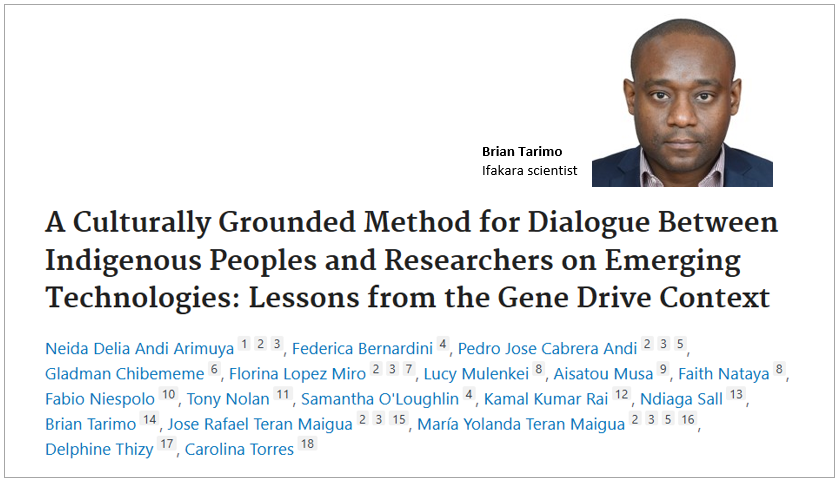
Published recently in Gates Open Research, the study was co-authored by experts from Africa, Latin America, Europe, North America and Asia. Among them was Brian Tarimo of Ifakara Health Institute in Tanzania.
A dialogue built on understanding
Unlike many public engagement exercises, the process was not designed to seek approval or rejection of gene drive technology. Instead, it focused on fostering mutual understanding and open exchange between scientists and communities.
Participants were encouraged to share their knowledge, traditions, experiences and concerns without pressure to reach a particular conclusion. Over time, the dialogue evolved through different engagement formats aimed at improving accessibility and ensuring broad participation.
Researchers say this flexibility was critical in overcoming practical barriers and ensuring that participation was not limited to those easiest to reach.
Why gene drives matter
Gene drives are genetic technologies that can spread specific traits faster than would occur naturally. Researchers are exploring their potential to reduce disease transmission, including malaria.
At the same time, the technology raises important questions about environmental safety, governance and who should have a voice in decisions about its development and potential use.
The dialogue sought to address these concerns by creating a trusted and culturally respectful environment where scientific knowledge and Indigenous perspectives could be shared openly.
Trust takes time
A key finding is that meaningful engagement cannot be achieved through short consultations or one-off meetings.
Instead, trust requires time, consistency and genuine listening. The dialogue was guided by principles of transparency, reciprocity, collective ownership and respect for Indigenous knowledge systems.
These principles shaped everything from the structure of meetings to the way discussions were facilitated. Scientists shared information about gene drive research, while Indigenous participants contributed traditional knowledge, lived experience and perspectives on environmental stewardship, highlighting the value of two-way learning.
According to the authors, recognizing Indigenous knowledge as valuable in its own right helped create a more balanced exchange between scientific and community perspectives.
Lessons beyond gene drives
Although the dialogue focused on gene drive research, the authors say the lessons apply to other emerging technologies.
They argue that early, meaningful engagement should be standard practice as science increasingly intersects with communities and ecosystems. Rather than focusing only on decisions, the process showed the value of building relationships and understanding shared values.
The researchers recommend that similar dialogue models be supported in discussions around other emerging technologies.
Why it matters
For many years, public engagement in science has been criticized for taking place too late in the research process or for failing to meaningfully include local voices.
The study adds to growing evidence that when engagement is built on trust and respect, it can strengthen relationships and improve how knowledge is shared and understood.
As debates around gene drive technology continue, the findings suggest that how conversations are conducted matters as much as the technology itself—shaping not only scientific progress, but who helps define its future.
Read the publication, here.