

CREATIVITY: Simple adjustments could improve predictions of malaria mosquito net durability
For millions of people living in malaria-affected regions, sleeping under a mosquito net can be lifesaving. But an important question remains: how long does the net protection last, especially after it has been washed many times?
To help answer this, health experts use a tool known as the Wash Retention Index (WRI). Introduced by the Collaborative International Pesticides Analytical Council (CIPAC), the WRI estimates how much insecticide remains on a net after a few numbers of washes. By measuring early wash performance, scientists can predict whether a net will continue to repel or kill mosquitoes over time.
The problem with the first wash
However, a new study published in the Malariaworld Journal recently has taken a closer look at this method and identified a key issue. Researchers found that including the first wash in WRI calculations can give misleading results.
The first wash often removes an unusually large amount of insecticide — not necessarily because the net is less durable, but due to how it was manufactured or stored before testing.
The researchers also found that the type of soap used in testing, whether standard laboratory soap or traditional Marseille soap, had little effect on polyethylene nets, which release insecticide
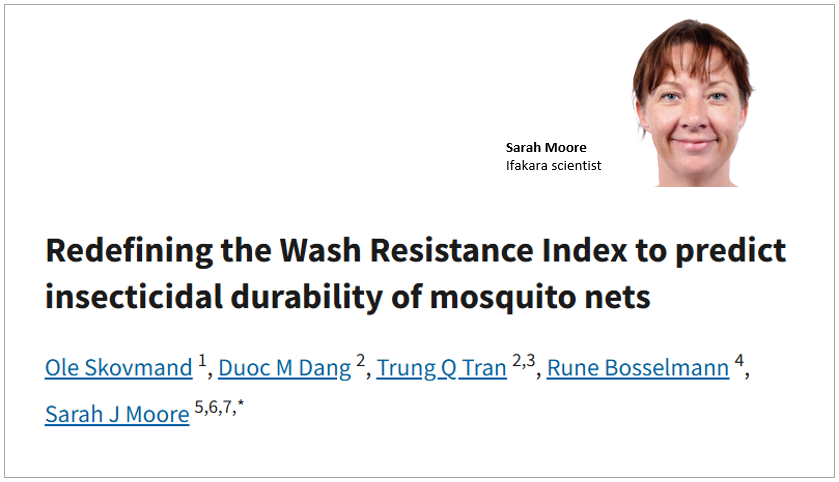
Ifakara scientists contributes to the study
The study, which includes contributions from Ifakara Health Institute senior scientist Sarah Moore, suggests that excluding the first wash from calculations provides a more accurate estimate of a net’s true durability, and gives a practical estimate of how nets will perform over their expected two- to three-year lifespan.
“Because surface insecticide may increase during storage due to diffusion from the polymer, we assessed the effect of excluding the first wash from index calculations to reduce storage-related variability,” the scientists explained.
Why these findings matter for malaria control
Insecticide-treated nets (ITNs) remain one of the most effective tools for malaria prevention. Yet their protective power declines over time, especially with repeated washing. To ensure quality, the World Health Organization currently recommends testing nets over 20 standardized washes — a process that is time-consuming and resource-intensive.
To streamline this, CIPAC developed the WRI as a faster way to estimate long-term durability using fewer washes. The new findings suggest that a revised WRI — one that excludes the first wash — could make durability testing both quicker and more reliable, without requiring the full 20-wash tests.
Although the study was done in a laboratory, its findings are useful in real life. By improving how we predict how long insecticide-treated nets last, regulatory authorities and manufacturers can make sure the nets remain effective for the full intended period — strengthening malaria control efforts across sub-Saharan Africa.
Read the publication, here.