

INNOVATION: Smarter way to detect disease outbreaks in animals, humans
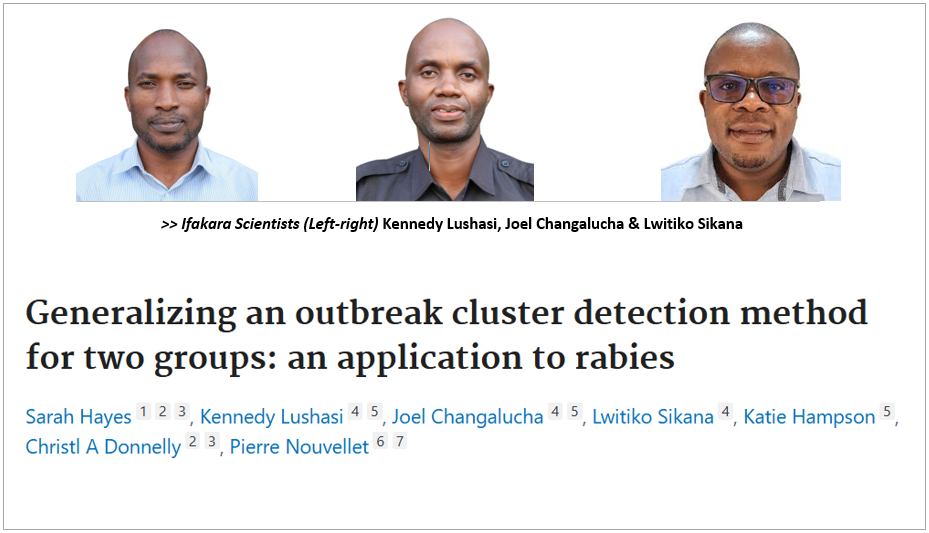
In a new study, scientists from the UK and Tanzania have introduced a new and improved method for identifying disease outbreaks, particularly when they occur across diverse groups: domestic animals, wildlife, or people.
This innovative method is important because it can help public health teams identify outbreaks more accurately and respond more quickly.
The study, published in Royal Society Open Science recently, involved contributions from scientists at the Ifakara Health Institute: Kennedy Lushasi, Joel Changalucha, and Lwitiko Sikana. The study was led by Sarah Hayes from the University of Liverpool (UK), with additional contributions from Katie Hampson (University of Glasgow), Christl A. Donnelly (University of Oxford), and Pierre Nouvellet (Imperial College London).
Why current outbreak detection methods fall short
Detecting disease outbreaks early is essential for preventing infectious diseases from spreading widely. Traditionally, detection methods group cases into “clusters,” assuming they come from a single population when in reality, diseases often spread across groups that differ in reporting, infection spread and transmission speed. These differences can make outbreaks harder to identify accurately.
To address this challenge, the researchers developed a generalized outbreak cluster detection method that accounts for these real-world differences. The method allows scientists to compare cases from two distinct groups, such as domestic animals and wildlife, while adjusting for differences in reporting and transmission patterns.
The new method takes these differences into account, tracking which groups are more likely to be reported and whether infections stay within or move between groups, providing a more realistic picture of disease spread.
Testing the method using rabies data
The researchers tested the method using rabies surveillance data from south-eastern Tanzania, focusing on cases reported in domestic animals (mainly dogs) and wildlife. Rabies is a deadly disease that affects both animals and humans and remains a major public health concern in many low- and middle-income countries.
Applying the new method to the rabies data showed that transmission between species is common, with many outbreaks involving both domestic animals and wildlife. As the researchers noted, “The results suggest that between-species transmission and mixed-species clusters are common, and that some assortative transmission is occurring.”
Key findings
The analysis revealed several important insights:
- Domestic animals were reported more frequently than wildlife, confirming that rabies cases in domestic dogs are more likely to be detected than those in wild animals.
- Rabies transmission distances were similar in domestic animals and wildlife, suggesting the disease spreads in comparable ways across species.
- Transmission between domestic animals and wildlife was common, meaning rabies does not circulate in isolation within a single group.
- While there was some tendency for transmission to occur within the same species, most outbreak clusters included both domestic and wild animals, showing how interconnected rabies transmission is.
Based on these findings, the researchers note that the new approach could also be applied to other diseases that spread between animals, such as bovine tuberculosis in wildlife and domestic animals, or even to human diseases where different age groups or populations are affected differently.
Why these findings matter?
Many infectious diseases do not spread within just one group, they move between animals, wildlife, or different segments of a population. At the same time, some cases are much more likely to be reported than others.
This novel method is especially useful for diseases that are always present at low levels, rather than causing sudden large outbreaks, and in situations where scientists cannot track who infected whom. By accounting for differences in reporting and disease spread, the method helps scientists identify outbreak clusters more reliably. This leads to a better understanding of how diseases spread and supports the design of more effective control strategies.
Overall, the study offers scientists and public health officials a more realistic and flexible way to understand disease outbreaks—bringing us closer to faster responses and stronger disease control for threats that affect both animals and people.
Read the publication, here.