

MALARIA CONTROL: Protecting people from mosquito bites outdoor
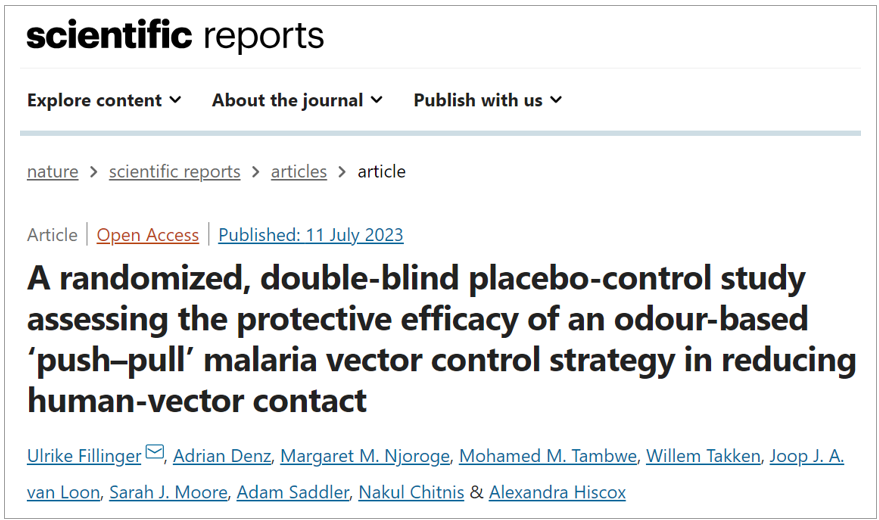
The necessity to continue looking for efficient methods for protecting people from mosquito bites outdoors has been underscored by recent study results, particularly assessing the use of odour-baited traps.
According to scientists, such novel outdoor mosquito control measures could be used in addition to traditional methods such as indoor residual spraying and long-lasting insecticidal nets in order to sufficiently eliminate malaria.
In the study published in the Nature journal in July, the scientists recommend expanding the toolbox for malaria vector control and utilizing other strategies, like manipulating mosquito vectors' odour orientation.
“There remains an urgent need to further develop and evaluate odour-baited attract-and-kill approaches that can be effectively combined with spatial repellents for a push–pull intervention for malaria control,” claimed the scientists in the paper.
“Novel malaria vector control strategies targeting the odour-orientation of mosquitoes during host-seeking, such as ‘attract-and-kill’ or ‘push-and-pull’, have been suggested as complementary tools to indoor residual spraying and long-lasting insecticidal nets. These would be particularly beneficial if they can target vectors in the peri-domestic space where people are unprotected by traditional interventions,” they added.
Push-and-pull interventions assessed
The scientists conducted a study in western Kenya in 2018 to assess the "push-and-pull" interventions proposed. For the ‘push’ intervention (spatial repellent), they used transfluthrin-treated fabric strips positioned at open eave gaps of houses while for the ‘pull’ intervention, they placed an odour-baited mosquito trap at a 5 m distance from a house.
In addition, they also used the combined ‘push–pull’ package and the control where houses contained all elements but without active ingredients. Outdoor biting was estimated using human landing catches, and indoor mosquito densities using light traps.
After implementing the study for 17 weeks during a rainy season between September and December, the scientists reported that none of the three tested interventions, ‘push’, ‘pull’ and the combined ‘push–pull’ system, reduced outdoor biting by either of the two abundant malaria vectors, An. arabiensis and An. funestus. On the contrary, the presence of a spatial repellent was associated with an increase of An. funestus biting outdoors.
None of the interventions offered protection
Although the study's findings show that none of the interventions offered any protection against outdoor biting malaria vectors, the researchers have stressed the need for more research into effective outdoor mosquito prevention.
“The need for finding highly efficient methods for protecting people from malaria vector bites outdoors remains important, as illustrated in our study, where a human landing volunteer received on average 23 bites from An. arabiensis per night during the 17 weeks of the survey during the rainy season. With 1% of the collected An. arabiensis being Plasmodium sporozoite positive, this would result in more than one infective bite per person per week.”
Ifakara Health Institute scientists, Mohamed Tambwe and Sarah Moore contributed to the study along with colleagues from partner institutions in Kenya, Switzerland and The Netherlands. They include Ulrike Fillinger (lead author) and Margaret Njoroge from the International Centre of Insect Physiology and Ecology (Icipe); Adrian Denz, Adam Saddler and Nakul Chitnis from Swiss Tropical and Public Health Institute; and Willem Takken, Joop J. A. van Loon and Alexandra Hiscox from Wageningen University and Research.
>> Read the publication: https://www.nature.com/articles/s41598-023-38463-5#Sec8