

WARNING: Rift Valley Fever silently circulating undetected in Tanzania
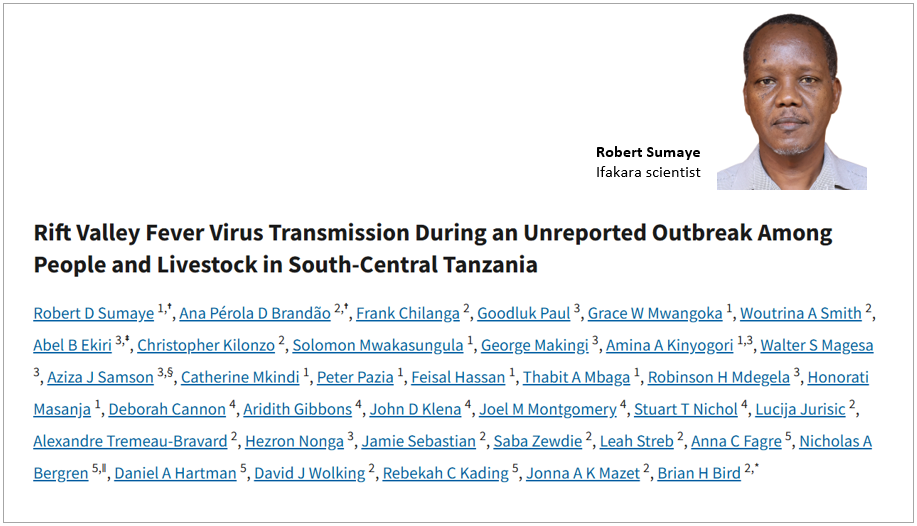
Rift Valley fever (RVF), a viral disease affecting both animals and humans, is circulating year-round in parts of Tanzania without being detected by routine surveillance, according to new research published on Viruses in October 2025.
The study, carried out between 2016 and 2018 in Iringa and Morogoro regions, monitored infections in people, livestock, and mosquitoes to understand how the virus spreads between species.
The study was co-led by Robert Sumaye of the Ifakara Health Institute and Ana Pérola Brandão of the One Health Institute at the University of California Davis (USA), with Brian Bird, also from the One Health Institute at UC Davis, as the last author. Additional Ifakara contributors included Grace Mwangoka, Solomon Mwakasungula, Amina Kinyogori, Catherine Mkindi, Peter Pazia, Feisal Hassan, Thabit Mbaga, and Honorati Masanja.
The study also involved colleagues from Sokoine University of Agriculture (Tanzania), the US Centers for Disease Control and Prevention (USA), and the Center for Vector-Borne Infectious Diseases at Colorado State University (USA).
Why it matters
RVF is a zoonotic disease that can cause periodic large-scale outbreaks in humans and livestock, leading to serious economic and public health impacts. The discovery that the virus may be circulating continuously suggests that cases in both people and animals could be going unnoticed. This ongoing transmission poses particular risks for farmers, livestock keepers, and pastoralist communities, particularly across Africa and parts of the Arabian Peninsula where outbreaks mostly occur.
By jointly tracking infections in humans, animals, and mosquitoes—a “One Health” approach—the researchers were able to identify transmission patterns early and pinpoint high-risk activities and groups.
As the researchers note, “This study provides a multi-year examination of interepidemic transmission of RVFV across human, animal, and vector populations in a region that is historically known to experience RVF outbreaks. We demonstrate that, over a two-year period with no formal disease outbreaks declared in central Tanzania, RVFV was actively being transmitted between vectors, livestock, and people.”
Key findings from the study
- Ongoing transmission: Testing of more than 1,300 people and 4,400 livestock showed that around 8% of humans and 10% of animals had evidence of recent or past RVF infection.
- Virus detected in humans and mosquitoes: Viral genetic material was found in eight human samples and 22 mosquito pools, confirming active circulation.
- Geographic and occupational risk: People in Iringa had higher exposure than those in Morogoro, and livestock owners faced greater risk than non-owners.
- Multiple mosquito species involved: The virus was detected in Culex and Anopheles mosquitoes, indicating that RVF transmission is not limited to Aedes, the species typically linked to outbreaks.
What are the next steps
The researchers recommend strengthening active surveillance and implementing evidence-based control strategies. These include community health education, improved livestock keeping practices to reduce contact with the virus, and coordinated vaccination campaigns for animals and humans in high-risk areas.
They conclude that tackling RVF across Africa requires closer cooperation between public health and veterinary sectors, noting that integrated “One Health” surveillance adds significant value by linking human, animal, and vector data to detect and respond to disease threats more effectively.
Read the publication, here.