

HEALTH POLICY: Politics, not just poverty, drives health inequalities, new study finds
A new study shows that politics and power—not just social conditions—play a major role in shaping people’s health. The research introduces a new “process-oriented framework” designed to help policymakers and health experts connect scientific evidence with the realities of policymaking, ultimately improving health outcomes.
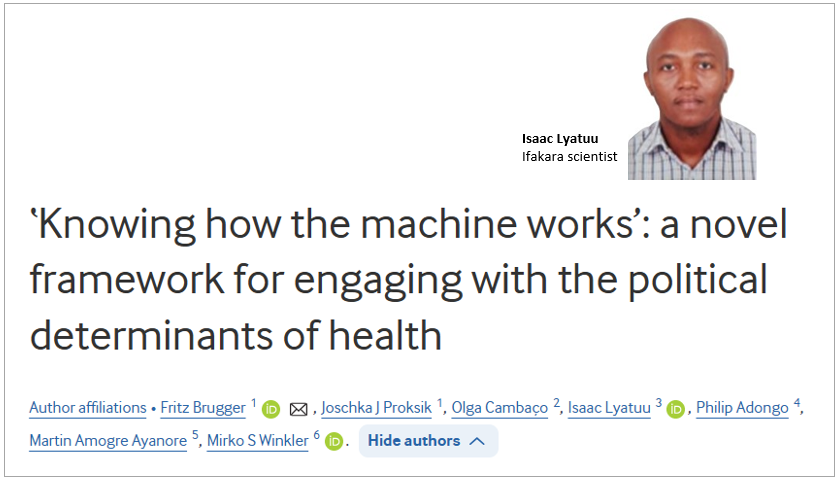
The paper, published in BMJ Global Health, features contributions from Dr. Isaac Lyatuu, a research scientist at the Ifakara Health Institute (IHI), alongside an international team of researchers from Switzerland, Ghana, and Mozambique. The study was led by Fritz Brugger of ETH Zürich.
Politics as hidden drivers of health
While public health research often recognizes social and economic factors in shaping health outcomes, the authors argues that it has largely overlooked the political side. “Policies and political processes influence equity and social determinants,” the authors note, emphasizing that real progress requires confronting these hidden drivers.
The authors call this system a “sorting machine” that creates social classes and unequal health outcomes—leaving social determinants as visible outcomes of deeper political processes.
A Five-step framework for change
To help researchers and policymakers address these issues, the researchers presents a five-step framework that include:
- Analyze how politics shapes policies in specific health issues.
- Identify how these processes cause unequal health outcomes.
- Use agile, flexible methods to engage with policymakers.
- Propose politically feasible yet more equitable options.
- Strengthen health outcomes through more strategic action.
This framework, the scientists explained is designed to help close the disconnect between research and policymaking. It can, they wrote, “help bridge the gap between evidence-based health interventions and the complex realities of policy, ultimately advancing health equity.”
Mining as a test case
The researchers applied the framework to mining regions in Burkina Faso, Ghana, Mozambique, and Tanzania over six years. They discovered:
- Of more than 560 mining projects in Africa, over 90% of impact assessments were not publicly available.
- In the few that were available, these assessments rarely included public health issues.
- Mining activities brought serious health risks—such as HIV infections, road accidents, and social disruption—that affected poor families, women, and migrants most. Meanwhile wealthier groups often benefited from new infrastructure and services.
These case studies highlight how politics and power shape whose voices count, whose health is prioritized, and who bears the risks.
Need for stronger structural competence
The researchers conclude that public health must go beyond medical and social factors and tackle the political forces that drive inequality. They call for stronger “structural competence”—training health scholars and professionals to understand and influence policy processes.
“To change outcomes, professionals must know how the machine works,” the authors argue. “Only then can public health research effectively translate into effective policy engagement.”
Read the publication here.