

INNOVATION: Ivermectin-treated cattle could help kill malaria-carrying mosquitoes
Researchers have found that treating cattle with ivermectin, a medicine used to control parasites, could help reduce the survival and reproduction of malaria-carrying mosquitoes, offering another way to strengthen malaria prevention in communities where livestock are common.
Despite progress in malaria control, mosquitoes continue to spread the disease across many parts of Africa. While insecticide-treated bed nets protect people while they sleep, some mosquitoes also feed on animals, allowing them to survive and continue spreading malaria.
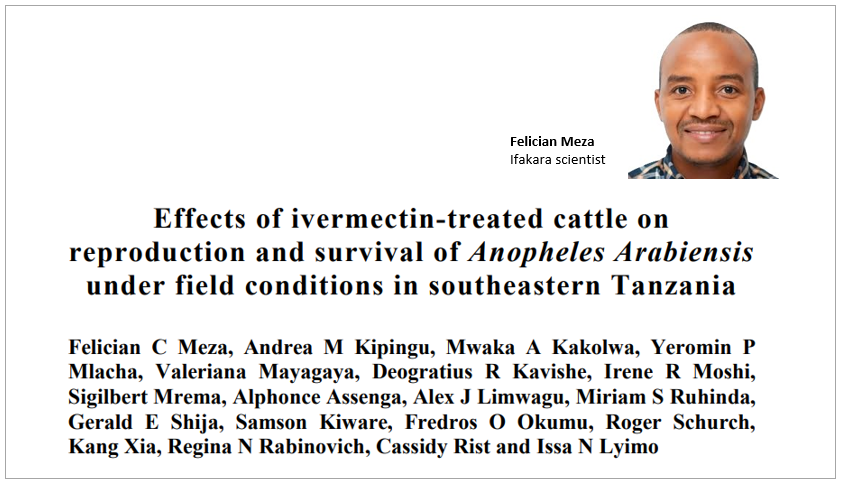
A new study led by Felician Meza, alongside fellow researchers from Ifakara Health Institute (IHI) and collaborating partners in the United States and Spain, suggests that treating cattle with ivermectin could help address this challenge by reducing mosquito survival and reproduction after feeding on livestock.
Testing a different approach to mosquito control
Conducted in Tanzania's Kilombero Valley in 2022, the study examined the effects of ivermectin-treated cattle on Anopheles arabiensis, one of the mosquito species responsible for spreading malaria.
Unlike mosquitoes that mainly feed on humans, Anopheles arabiensis can feed on both people and animals. This makes the species particularly difficult to control using methods that primarily protect humans from mosquito bites.
To test the approach, researchers randomly divided 22 cattle into two groups. One group received ivermectin treatment, while the other remained untreated for comparison.
During both wet and dry seasons, the cattle were exposed to wild mosquitoes under natural field conditions. Researchers then collected mosquitoes from cattle enclosures to examine their feeding behaviour, survival and ability to reproduce.
Mosquito deaths increased three to four times
The findings, published in the Mosquito Journal recently, revealed that treating cattle with ivermectin did not reduce the number of mosquitoes attracted to the animals or their ability to feed on blood.
However, mosquitoes that fed on treated cattle were three to four times more likely to die than those feeding on untreated animals.
The treatment also reduced the number of eggs produced by female mosquitoes and their likelihood of laying eggs.
This means that although mosquitoes could still feed on treated cattle, they were less likely to survive and produce the next generation of mosquitoes.
Why this matter for malaria prevention?
The findings point to a promising additional approach to malaria control, particularly in rural communities where people and livestock live close together.
By reducing mosquito survival and reproduction, treating cattle with ivermectin could help reduce mosquito populations over time and potentially lower malaria transmission.
While further research is needed to determine its wider impact on malaria transmission, the study underlines the potential of targeting mosquitoes that feed on livestock to strengthen malaria prevention efforts in Tanzania and other livestock-rearing communities across Africa.
Read the publication here.