

MOSQUITOES: Study uncovers hidden diversity in species to guide targeted malaria control in Tanzania
Choosing the right tools to fight malaria starts with knowing which mosquitoes and parasites are present, and where. A new study across Tanzania Mainland has uncovered previously undetected mosquito species and parasites, revealing important gaps in routine surveillance and offering fresh insights for malaria control.
The findings come from research led by scientists at Ifakara Health Institute (IHI), working with international partners to investigate mosquito and parasite diversity using advanced DNA-based technology.
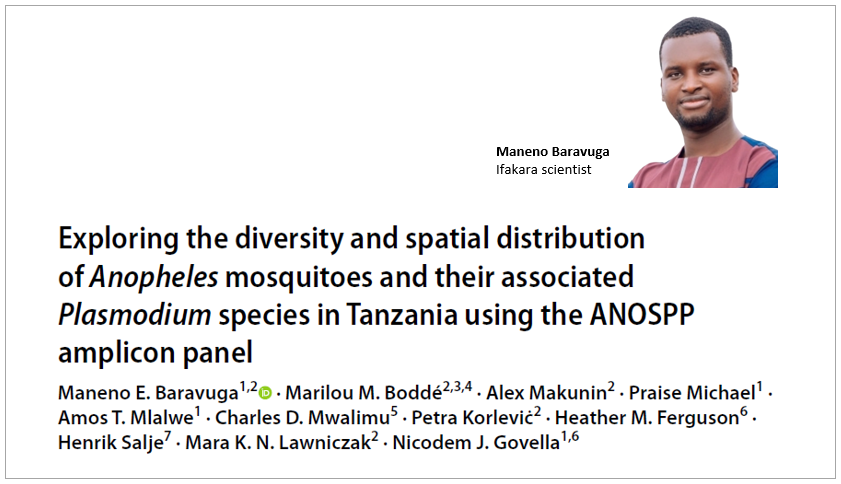
Published recently in Parasites & Vectors, the study was led by IHI scientist Maneno Baravuga, alongside colleagues Praise Michael, Amos Mlalwe and Nicodem Govella, in collaboration with the Wellcome Sanger Institute, University of Cambridge, University of Glasgow and Tanzania's National Malaria Control Programme.
Over 71,000 mosquitoes examined
Between 2020 and 2023, researchers collected 71,146 mosquitoes across 25 districts in mainland Tanzania. Of these, 10,020 belonged to the Anopheles group, which includes mosquitoes responsible for spreading malaria.
Using a DNA-based technology known as ANOSPP, researchers identified 15 Anopheles species, including some that conventional identification methods had missed.
Among the discoveries was the first recorded presence of Anopheles funestus-like in Tanzania and the first molecular identification of Anopheles longipalpis Type C in the country.
The study also revealed mosquito species and groups that had been entirely missed by conventional methods, which identify mosquitoes based on their physical appearance. These included Anopheles marshallii sensu lato and Anopheles pretoriensis.
A surprising discovery involving parasites
Beyond mosquitoes, researchers detected all four major human malaria parasites reported in Tanzania in mosquitoes collected from the wild.
They also identified Plasmodium caprae, a parasite associated with goats, for the first time in Tanzania. Its detection in Anopheles arabiensis mosquitoes was also a global first.Together, these findings reveal a more complex picture of circulating malaria parasites.
Why these findings matter for malaria control
Not all mosquitoes behave the same way. Some bite indoors, others outdoors, while their feeding preferences and responses to malaria prevention measures can differ.
These differences matter because malaria prevention strategies that work well in one area may not be equally effective elsewhere.
By identifying which mosquito species and parasites occur in different locations, the findings provide evidence to support subnational tailoring, an approach that adapts malaria interventions to the specific conditions and risks of each area.
“This national-scale picture can help guide local action. Mosquito species differ in when and where they bite, their feeding preferences and their responses to control measures. Mapping both mosquitoes and parasites helps programmes choose interventions suited to each area,” said Maneno Baravuga, the study's lead author.
The researchers also emphasize that conventional surveillance remains valuable, but combining it with advanced DNA-based identification could provide a more complete picture of malaria transmission risks and support more targeted malaria control efforts across Tanzania.
Read the publication here.