

HEALTH FINANCING: Reforms in Tanzania show promise—but implementation remains key
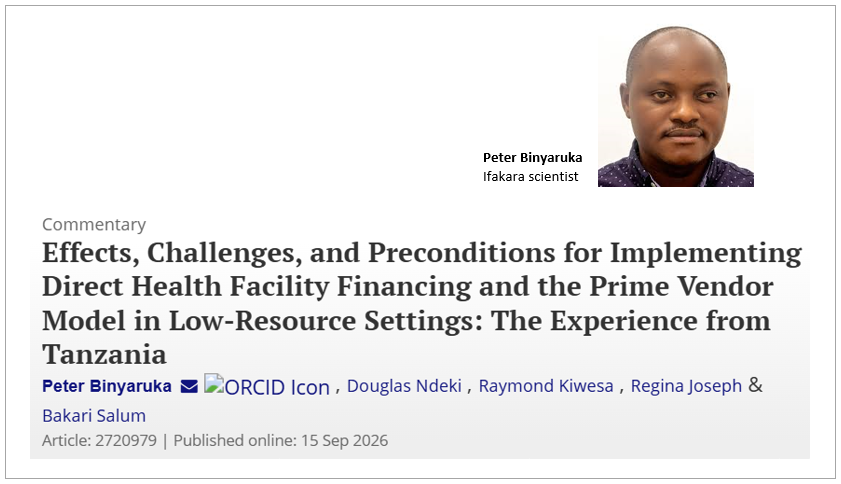
Greater financial autonomy can help health facilities respond to local needs and improve access to medicines—but delays, capacity gaps and procurement challenges can limit the gains, a new study finds.
The study, published recently in Health Systems & Reform, examines Tanzania’s experience with two health-financing reforms: Direct Health Facility Financing (DHFF), which gives health facilities greater control over their funds, and the Prime Vendor Model, which allows them to source medicines from approved private suppliers.
Led by Dr Peter Binyaruka of the Ifakara Health Institute (IHI), together with colleagues from Tanzania’s Prime Minister’s Office – Regional Administration and Local Government (PMO-RALG), the study examines how the reforms have worked in practice and what is needed to sustain their benefits in low-resource settings.
Its findings suggest that financial autonomy alone is not enough. When facilities cannot access medicines on time, face procurement challenges, or suppliers wait too long to be paid, the benefits of giving facilities greater control over their finances can be undermined.
Bringing decisions closer to facilities
Under DHFF, funds are transferred directly to health facilities, giving them greater control over planning and using resources according to local service needs.
The Prime Vendor Model complements the DHFF approach by allowing facilities to purchase medicines and other health commodities from accredited private suppliers when required products are unavailable through the public supply system.
Together, the reforms give health facilities greater flexibility to respond to local needs and address gaps in the availability of essential medicines and supplies. DHFF strengthens financial autonomy at the facility level, while the Prime Vendor Model provides an alternative source of medicines and supplies when stock-outs occur.
But autonomy comes with responsibilities
The experience also shows that greater responsibility does not automatically translate into better services.
The researchers identify several implementation challenges, including delays in fund disbursement, payment delays to suppliers, procurement bottlenecks and limited capacity for financial and procurement management.
These challenges can limit the benefits of reforms designed to make health facilities more responsive and efficient.
What needs to change
The researchers argue that successful implementation requires more than introducing new financing and procurement mechanisms.
Health facilities need adequate financial-management and procurement skills, clear rules, effective oversight and supportive supervision. Timely release of funds and payments to suppliers are also essential.
The study further highlights the need for “continued investment” in institutional capacity, digital systems and governance, alongside sustained political commitment and alignment with wider national health-financing and health-system policies.
Why this matters
As Tanzania advances efforts to strengthen health financing and achieve Universal Health Coverage (UHC), the experience offers an important lesson: giving health facilities greater financial autonomy must go hand in hand with strengthening the systems needed to support it.
For DHFF and the Prime Vendor Model to achieve their full potential, the authors conclude that they must be supported by strong systems for strategic purchasing, accountability and timely procurement. Together, the reforms can improve service responsiveness and quality of care, reduce medicine stock-outs and support Tanzania’s progress towards UHC.
Read the publication here.