

MODELLING STUDY: Next-generation nets projected to prevent more malaria
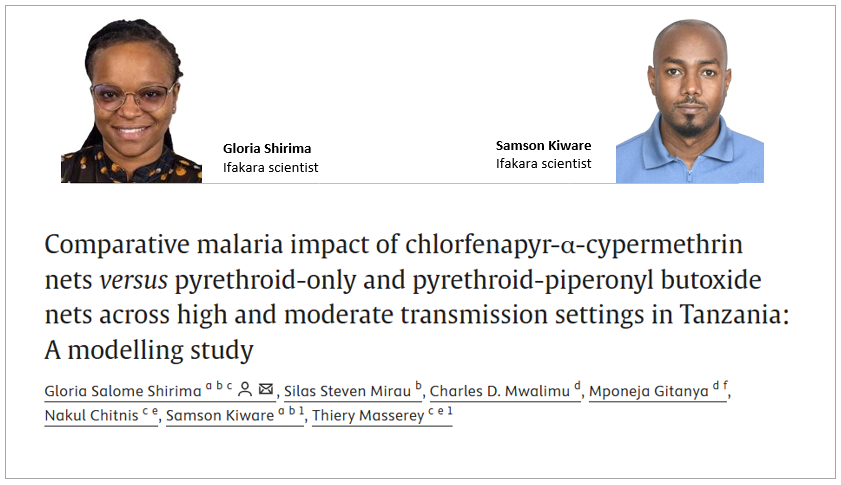
A Tanzania study suggests that next-generation mosquito nets could prevent more malaria and deliver sustained impact compared to conventional nets.
For millions of people in Tanzania, sleeping under an insecticide-treated mosquito net is one of the simplest ways to reduce the risk of malaria. But as mosquitoes develop resistance to commonly used insecticides, the question facing malaria control programmes is becoming more complex: which nets can provide the greatest protection, for how long, and at what cost?
A new modelling study led by researchers from Ifakara Health Institute and collaborators in Tanzania and Switzerland has explored that question, comparing three types of insecticide-treated nets across malaria settings in Tanzania.
The study modelled the potential impact of chlorfenapyr-alpha-cypermethrin nets, pyrethroid-piperonyl butoxide (PBO) nets, and standard pyrethroid-only nets in areas with moderate and high malaria transmission.
The research was led by Gloria Shirima, under the supervision of Samson Kiware—both from IHI—together with collaborators from the Nelson Mandela African Institution of Science and Technology, Tanzania’s National Malaria Control Programme, KCMC University, the University of Basel and Swiss TPH.
Looking beyond the traditional mosquito net
Published in Current Research in Parasitology & Vector-Borne Diseases, the study sought to understand what could happen if the different nets were deployed at scale in Tanzania.
Standard insecticide-treated nets rely mainly on pyrethroids to kill or repel mosquitoes. However, resistance to these insecticides has become a challenge in malaria control. Newer nets combine different insecticidal ingredients designed to overcome some of these limitations.
Drawing on data from experimental hut studies conducted in Tanzania, the researchers simulated how the different nets could affect malaria transmission over time.
The researchers considered three common delivery methods: targeted mass distribution campaigns, the School Net Programme, and distribution through reproductive and child health services.
Newer nets projected to prevent more malaria
Across both moderate- and high-transmission settings, the model projected that chlorfenapyr-alpha-cypermethrin nets could prevent more malaria episodes per person each year following a mass distribution round than either PBO or standard pyrethroid nets.
The model also indicated that the impact of chlorfenapyr-alpha-cypermethrin nets remained high through the third year after distribution, suggesting a more sustained epidemiological effect than PBO nets in the scenarios studied.
For communities, this matters because the effectiveness of malaria prevention does not depend only on whether people receive a mosquito net, but also on how well that intervention continues to protect people over time.
What about the cost?
While effective, the newer nets, however, come with a higher unit price, meaning that replacing conventional nets with them would require greater upfront investment.
But the modelling found that chlorfenapyr-alpha-cypermethrin nets had a competitive cost per malaria case prevented compared with PBO and standard pyrethroid nets.
This suggests that while the newer nets may cost more per net, their greater projected impact could make them a cost-effective option when the number of malaria cases prevented is considered.
Why this matters to Tanzania
The findings add to growing evidence on how next-generation mosquito-treated nets could help Tanzania respond to insecticide resistance and changing malaria transmission patterns.
They could also help inform Tanzania's National Malaria Control Programme make decisions about which nets to use, where to deploy them and through which delivery channels, particularly as malaria transmission varies across the country.
By modelling different scenarios before large-scale deployment, the study provides a way to assess the potential health impact and value for money of different net options, helping inform malaria-control strategies and resource allocation.
Importantly, the findings are modelled projections, not results from a new community trial. They complement evidence from field studies and can help guide further research and decisions on the potential use of chlorfenapyr-alpha-cypermethrin nets in Tanzania.
Read the publication here.