

MATERNAL HEALTH: Health facility data could improve how Tanzania measures deaths
As more women give birth in health facilities, researchers say the data generated there could provide a valuable way to improve how maternal deaths are measured.
Accurately measuring maternal deaths is essential for understanding the risks women face during pregnancy and childbirth, identifying where improvements are needed and tracking progress towards reducing preventable deaths.
However, in many low- and middle-income countries, measuring maternal mortality remains challenging because death registration systems are often incomplete or absent. This can leave health authorities working with data that may not fully show where women are dying or why.
A scientific paper published in July in the Bulletin of the World Health Organization highlights an opportunity to address this challenge by making better use of data collected at health facilities, where an increasing number of women now give birth.
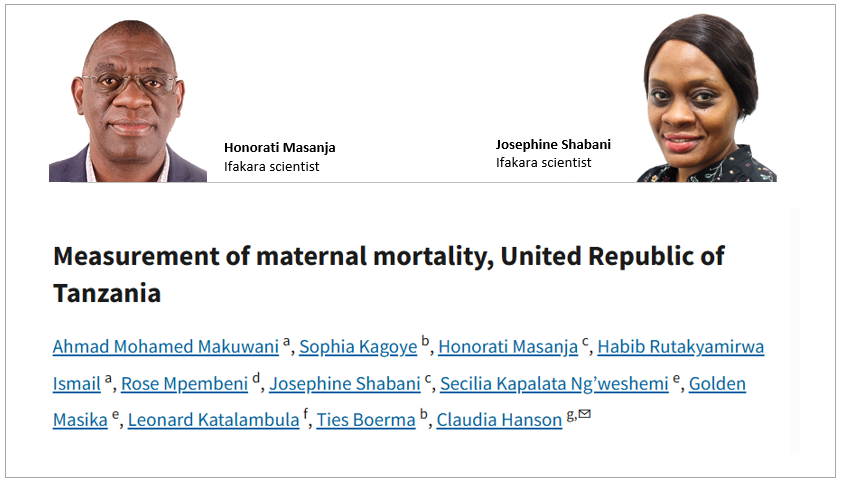
The paper was co-authored by researchers from the Ministry of Health, Ifakara Health Institute (IHI), Muhimbili University of Health and Allied Sciences, University of Dodoma and international institutions. IHI researchers among the authors include Dr. Honorati Masanja and Josephine Shabani.
Health facilities could provide valuable maternal mortality data
The paper notes that in about two-thirds of low- and middle-income countries, more than 80% of births now take place in health facilities.
This creates an opportunity to use facility data not only to improve the quality of care but also to contribute to estimates of maternal mortality at national and subnational levels. However, for facility data to play this role, the researchers emphasize that the quality of the data must be assessed and improved.
This means health facilities can provide an important source of information on maternal deaths—not only to help hospitals and health authorities improve the quality of care, but also to contribute to estimates of maternal mortality at national and subnational levels.
Four quality checks for better maternal mortality data
Using Tanzania as an example, the researchers propose four simple quality metrics to assess whether routine facility data are complete and internally consistent:
1. Are the reported maternal mortality levels and patterns plausible?
Do the numbers make sense across different regions or over time?
2. What is the ratio of stillbirths to maternal deaths?
An unusual pattern may indicate problems with reporting or data completeness.
3. What are the reported causes of maternal death?
The distribution of causes can help identify inconsistencies or possible misclassification.
4. What proportion of maternal deaths occur among women aged 35 years and older?
This provides another way of checking whether the reported data are internally consistent.
The researchers argue that using these metrics together can help identify gaps or inconsistencies before the data are used to guide health planning and decision-making.
Why the findings matter
The findings point to an opportunity to strengthen how Tanzania and other countries measure maternal mortality by making greater use of information already collected at health facilities.
As institutional births increase, the researchers argue that facility-based maternal mortality ratios could become an important input into national and subnational estimates of maternal mortality.
Better facility data could also help produce more stable mortality estimates and become particularly important if household surveys such as the Demographic and Health Surveys (DHS) do not resume in some countries because of funding challenges.
Strengthening Tanzania’s health information systems
To improve the quality of facility-based maternal mortality data, the researchers recommend three key actions.
- Individual reporting of maternal deaths using standardized classification of causes of death.
- Countries should establish centralized data-quality assessments using the four proposed metrics.
- Regular national on-site assessments of maternal and perinatal deaths reporting
The researchers also call for further studies to assess how completely maternal deaths are reported in health facilities and to estimate deaths occurring in communities, which can help inform adjustments to facility-based estimates.
Better data for better decisions
For Tanzania, the study highlights an opportunity to strengthen existing health information systems and make better use of routine facility data.
The message is not simply about counting more maternal deaths but, making sure the deaths that are reported are captured accurately, classified correctly and assessed for quality.
As countries work towards the Sustainable Development Goal target of reducing maternal mortality to fewer than 70 deaths per 100,000 live births by 2030, strengthening the systems used to measure maternal deaths will remain an important part of the effort.
Read the publication here.