

TRANSMISSION: Study finds most malaria exposure in Pemba happens outdoors
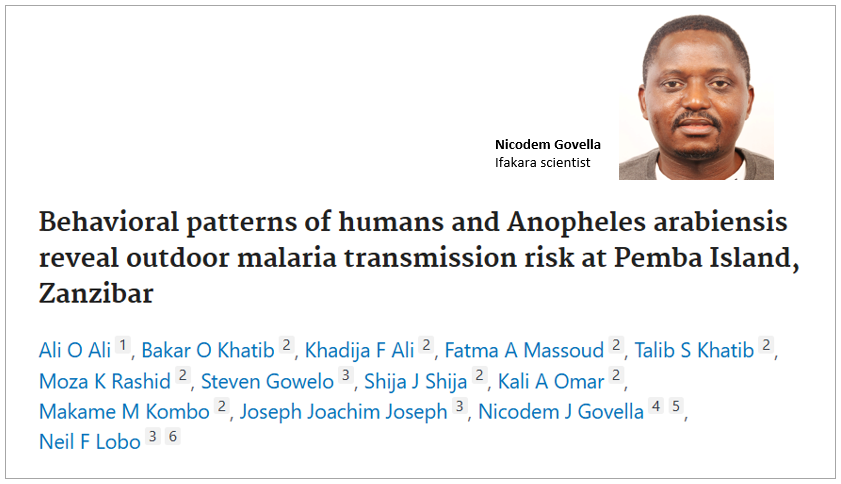
Despite Zanzibar’s success in keeping malaria prevalence very low, a new study has found that much of the remaining malaria risk on Pemba Island may be happening outside homes—where bed nets and other indoor-focused interventions offer limited protection.
The study found that about 82% of mosquito bites occurred outdoors, with most unprotected exposure happening while people were awake. The findings point to human behaviour and outdoor-biting mosquitoes as important pieces of the puzzle in Zanzibar’s efforts to eliminate malaria.
The study found that 98% of the Anopheles gambiae mosquitoes identified belonged to Anopheles arabiensis, a mosquito known for biting outdoors.
Published in Malaria Journal, the study was conducted between February 2024 and January 2025 across four districts of Pemba Island. Researchers collected adult malaria mosquitoes both indoors and outdoors while also observing how people spent their time, including where they were, what they were doing and whether they were using insecticide-treated nets.
Ifakara seasoned researcher, Dr. Nicodem Govella, is the last author and supervisor. He worked in collaboration with colleagues from the Zanzibar Malaria Elimination Program (ZAMEP) and Malaria Elimination Initiative, University of California San Francisco, San Francisco, USA.
When people and mosquitoes meet
The researchers collected 981 Anopheles mosquitoes during the study. Mosquitoes were more than four times as likely to be collected outdoors than indoors.
The peak biting period was also striking. Mosquito biting was highest between 7:00 and 8:00 p.m., both indoors and outdoors—a time when many people are still awake and going about their evening activities.
Overall, about 85% of unprotected malaria exposure occurred outdoors while people were awake. This means that even when people are protected inside their homes by bed nets, they may still be exposed to infected mosquito bites before going to bed or while spending time outside in the evening.
For malaria elimination programmes, the finding highlights a difficult challenge: the mosquito and the person do not always meet in the bedroom.
Children and adults face different risks
The study found that malaria exposure was not the same across age groups. Children under five experienced relatively more exposure indoors, where insecticide-treated nets provided substantial protection.
But as children grew older, their exposure increasingly shifted outdoors.
School-aged children and adults were predominantly exposed outdoors, potentially reflecting differences in daily routines, school activities, social interactions and evening activities. The researchers also found differences between men and women. Men experienced greater outdoor exposure than women, while women experienced more indoor exposure while they were awake.
These differences suggest that malaria prevention may need to consider where people spend their time, when they are outdoors and what they are doing, rather than relying on a one-size-fits-all approach.
Bed nets are working—but cannot stop every bite
The findings do not diminish the importance of insecticide-treated nets. In fact, the study found that ITNs provided substantial protection for young children, who experienced more indoor exposure.
However, the proportion of exposure prevented by bed nets declined as age increased. This creates a growing protection gap for older children and adults, whose malaria exposure is increasingly taking place outdoors.
For communities that have already achieved high coverage of indoor interventions, this residual outdoor transmission could become increasingly important.
A new challenge for malaria elimination
Zanzibar has made major progress against malaria through widespread use of indoor residual spraying and insecticide-treated nets. But the persistence of malaria transmission, particularly on Pemba, suggests that these tools alone may not be enough to eliminate every remaining infection.
The study points to outdoor-biting Anopheles arabiensis and evening human activity as major contributors to this residual transmission. This could mean that the next phase of malaria elimination will need to move beyond the walls of the home.
Taking malaria prevention outdoors
The researchers conclude that Zanzibar’s malaria elimination efforts will require additional interventions that address outdoor transmission and human behaviour alongside existing indoor measures.
Such approaches could include interventions designed specifically to reduce mosquito-human contact outdoors, combined with strategies that consider when and where people are most exposed.
The message from Pemba is clear: protecting people from malaria may increasingly require understanding not only where mosquitoes bite, but also where people live their lives.
As Zanzibar works towards eliminating malaria, closing this outdoor protection gap could be critical to ensuring that the progress already achieved is not lost—and that the last remaining infections become increasingly difficult for malaria to sustain.
>> Read the full publication, here.