

REVIEW: Evidence points to promise in aquatic predators for reducing mosquitoes
As mosquito-control efforts face growing challenges, including insecticide resistance, researchers are looking beyond conventional tools to find new ways of keeping mosquito populations in check.
One possibility comes from nature itself: fish, insects and other aquatic predators that naturally feed on mosquitoes during their early stages of life.
The idea fits into a wider conversation taking place this week at the PAMCA Kenya Chapter Annual Meeting 2026 in Nairobi, where researchers, policymakers and other experts are discussing how to “Reconnect and reimagine mosquito control in Africa.” One of the conference’s sub-themes focuses on emerging technologies and interventions and integrated vector management (IVM)—an area that closely aligns with the potential use of aquatic predators as complementary mosquito-control tools.
Targeting mosquitoes before they can fly
Mosquitoes spend an important part of their early life in water, where their eggs hatch and larvae develop before becoming adults. This makes breeding sites a potential target for controlling mosquito populations before they mature into disease-carrying adults—and researchers are asking whether nature itself could help.
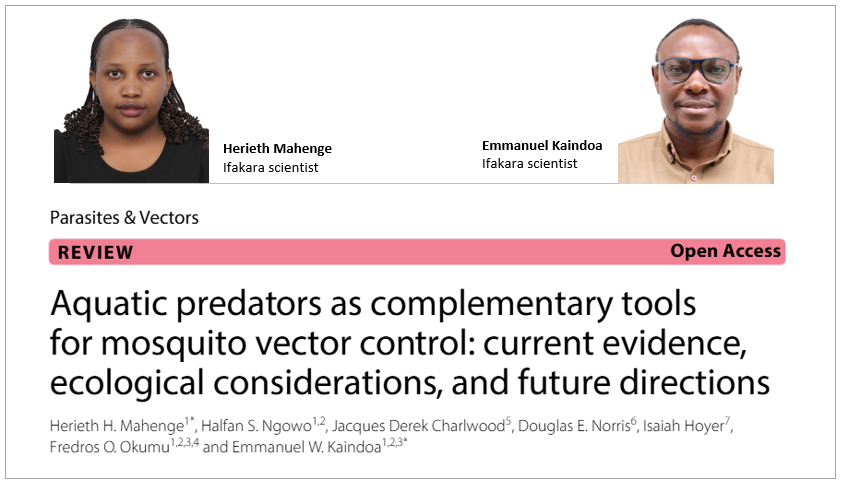
A new review by researchers from Ifakara Health Institute and partner institutions in the United States and Portugal has examined whether aquatic predators could play a role at this stage of the mosquito life cycle.
The review, published in Parasites & Vectors, was led by Herieth Mahenge, with Emmanuel Kaindoa serving as senior author. It brought together evidence from laboratory experiments, semi-field studies and field investigations.
“Overall, aquatic predators represent promising complementary tools rather than standalone solutions,” the authors note, adding that their successful integration into mosquito-control programmes will depend on local ecological and operational conditions.
More than simply eating larvae
The researchers found evidence that aquatic predators can reduce mosquito populations. The most direct effect is through feeding on mosquito larvae, but predators may also influence mosquito behaviour and survival, making breeding sites less favourable for mosquitoes.
These effects could make natural predators a useful addition to mosquito-control programmes, particularly as mosquitoes develop resistance to some insecticides.
Why this matter
Mosquito-borne diseases remain a major public health challenge, while insecticide resistance continues to threaten some of the tools used to control their spread. Finding safe and sustainable ways to complement existing interventions could therefore help strengthen efforts to keep mosquito populations under control.
But key questions remain
The researchers caution, however, that reducing mosquito numbers does not necessarily mean reducing disease.
Although many studies have shown that aquatic predators can suppress mosquito populations, there is still limited evidence that this leads directly to fewer cases of malaria or other mosquito-borne diseases. Most of the available evidence also comes from laboratory and semi-field studies, with relatively little research from real-world settings.
The use of predators must also be carefully considered from an environmental and practical perspective. Introducing or increasing predators could affect other organisms and the wider aquatic ecosystem. Their cost, feasibility, scalability, long-term sustainability and acceptance by communities also need to be assessed.
The researchers therefore call for more well-designed field and epidemiological studies to establish which predators work best, where they can be used safely and whether they can make a meaningful contribution to reducing disease transmission.
Reimagining control, not replacing what works
For now, the evidence points to aquatic predators as a promising complement, rather than a replacement, for existing mosquito-control methods.
Their potential lies in becoming part of a broader, locally adapted approach to integrated vector management. If further research confirms their value, mosquito-control programmes could make better use of one of nature’s oldest strategies.
As the mosquito-control community gathers in Nairobi to consider how Africa can reconnect with and reimagine its approaches to mosquito control, this review offers one example of what that reimagining could look like: working with nature, alongside existing tools, to find new ways of keeping mosquitoes in check
Read the publication here.